
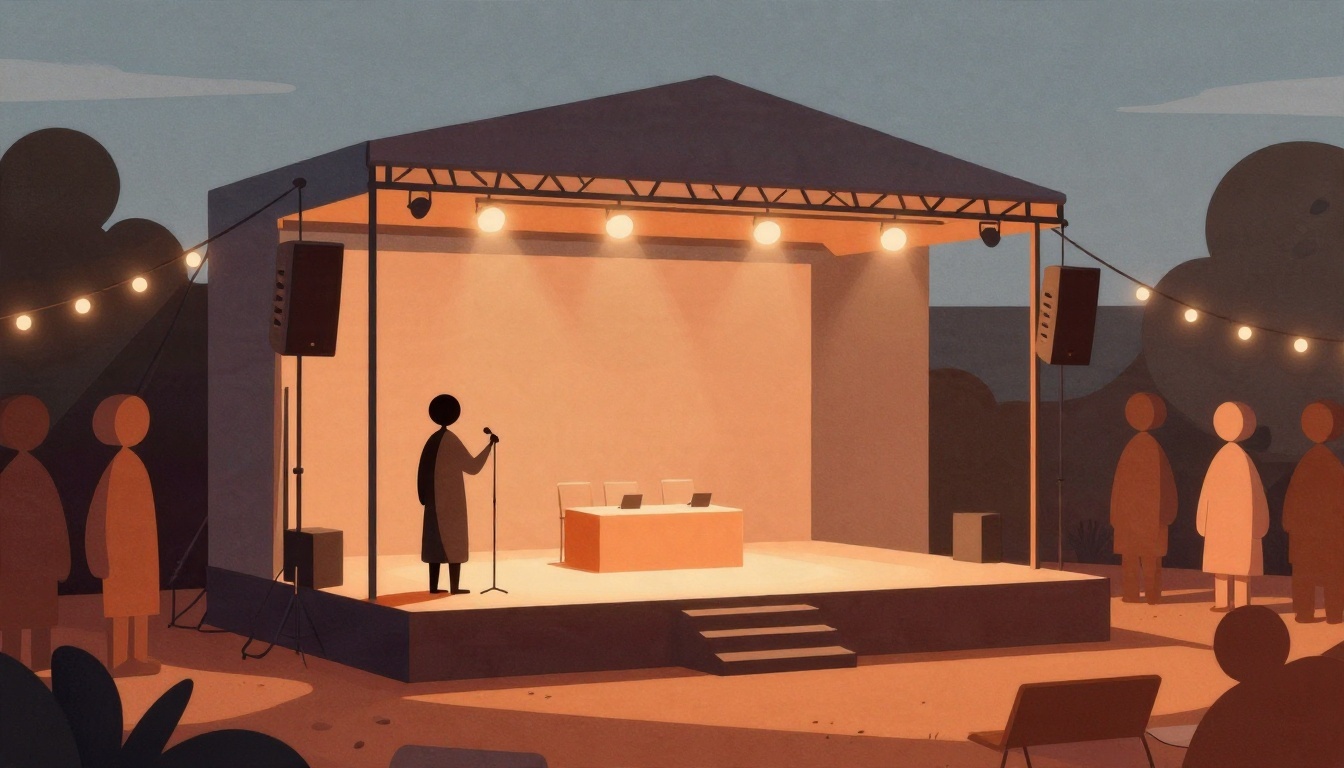
Outdoor festivals are loud, bright, and spread out—which makes them uniquely difficult to make accessible for Deaf and hard-of-hearing attendees. Sound carries, but sightlines don't. If you're planning a street fair, music festival, or community celebration, communication access has to be designed into the site, the stage, and the schedule from the start, not patched in after a request arrives.
According to best practices for ASL in live music, where should interpreters be placed?
Select one answer.
Start with the site and the sightlines
Outdoor events fail Deaf attendees most often because there's nowhere to look. The ADA National Network's planning guide for temporary events treats communication access as a core planning category alongside parking and routes, and that framing matters: interpreters, captioning, and visual information are infrastructure, not extras.
Before you book anything, walk the site and ask:
- Where will an interpreter stand, and is there steady front lighting so hands and faces are visible?
- Is there shade or a backup plan when the sun moves behind the stage?
- Can a Deaf attendee see the stage, the interpreter, and any screens from one reserved area?
- Are there reflective surfaces, backlit banners, or busy backgrounds that swallow sign language?
Reserve a section at the front of the audience for Deaf and hard-of-hearing attendees, as recommended in Augsburg University's accessible event planning guide. That section should have clear line of sight to both the performer and the interpreter.
Get the stage setup right for ASL
The National Independent Venue Foundation's best practices for ASL in live music are blunt about the essentials: place interpreters in clear sightlines of Deaf patrons with steady front lighting and safe stage access. Outdoors, that means planning for the sun, not just the spotlights.
Practical stage checklist:
- Position the interpreter at stage left or another fixed, well-lit spot—not wandering the crowd.
- Provide a dedicated light on the interpreter that works at dusk and after dark.
- Give interpreters the set list and lyrics in advance so they can prepare.
- Book qualified interpreters with music or performance experience early, and budget for prep and travel time.
- Coordinate with artists about sharing materials; when lyrics aren't available, interpreters need extra prep time.
At Wolf Trap, interpreters work in a well-lit section of the stage in clear view of patrons, and the venue pairs a Deaf interpreter with a hearing interpreter for performances—a model worth considering for headline sets.
Make information visual everywhere
A festival is a maze of announcements, schedules, and safety instructions. If those only exist as spoken words over a PA system, Deaf attendees miss them.
- Provide large-print and digital schedules, maps, and safety information.
- Use captioning or a visual display for stage announcements and emergency instructions.
- Train staff and volunteers on how to communicate with Deaf attendees—gestures, written notes, and clear pointing all help.
- Publish an accessibility statement on your website and ticketing page so people know what to expect before they arrive.
Plan for the whole day, not just the headliner
Access needs don't start when the music does. Think through the full attendee journey: arrival, ticketing, food lines, restrooms, first aid, and exit. The Mid-Atlantic ADA Center's accessible meetings guide covers registration and communications as part of accessibility, and the same logic applies outdoors.
A quick pre-event checklist:
- Confirm interpreter coverage for every programmed segment, including panels and announcements.
- Reserve front-row seating and mark it clearly on the site map.
- Brief vendors on basic communication access.
- Have a named accessibility lead on site for the whole event.
- Collect feedback afterward and use it for next year.
How the Featured Expert Can Help
Unspoken Events Co., LLC is a Deaf-owned, women-owned, and disabled-owned inclusive event strategy and accessibility consulting firm based in Central Ohio. Founded by Heidi DeGrace, the firm partners with businesses, nonprofits, schools, and community organizations on event strategy, accessibility consulting, and community connection. Learn more at unspokeneventsco.com.
Quiz: Test your outdoor festival access knowledge
Outdoor festivals add sun, distance, and noise to the accessibility equation. See if you can spot the stage setup detail that matters most for Deaf attendees.
{"question":"According to best practices for ASL in live music, where should interpreters be placed?","options":["In clear sightlines of Deaf patrons with steady front lighting and safe stage access","At the back of the crowd so they don't block the stage","In a shaded area away from the stage to avoid glare"],"correctIndex":0}