
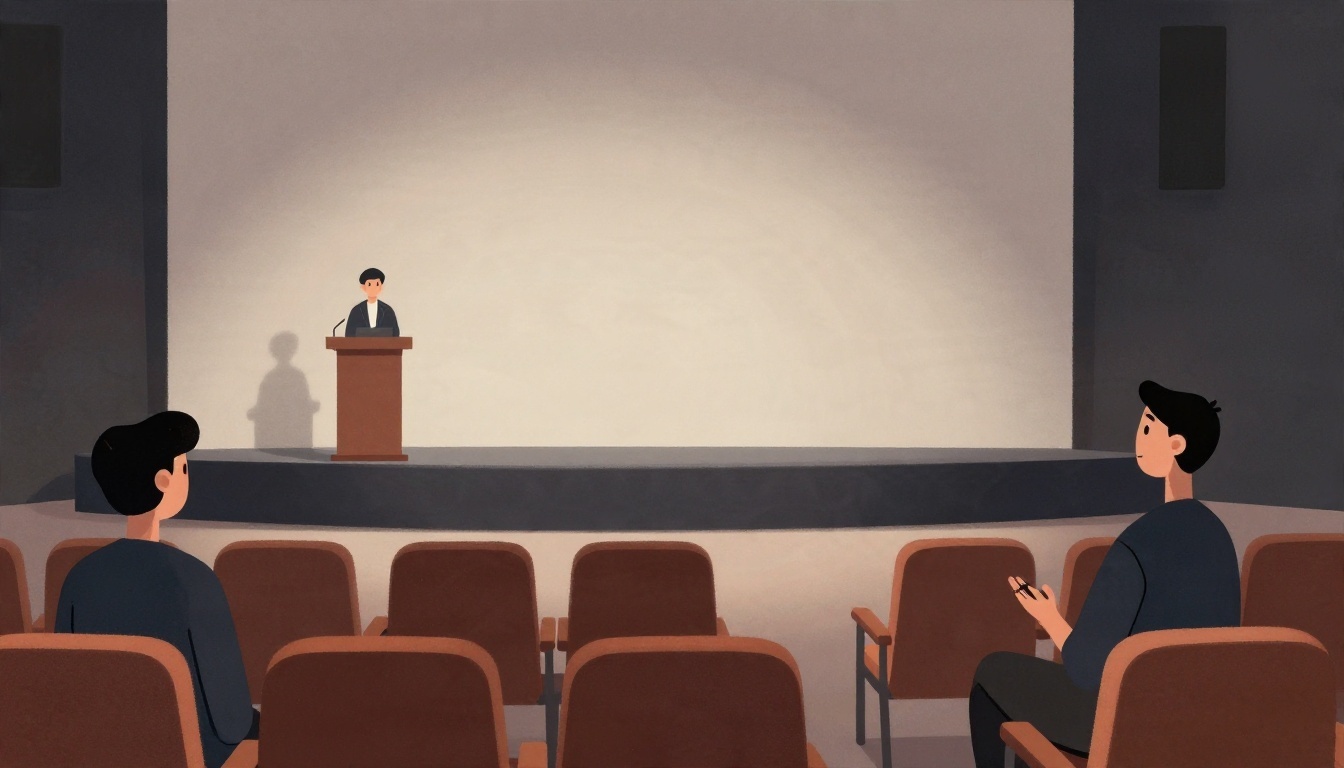
According to accessibility best practices for conferences, where should reserved seating for Deaf and hard-of-hearing attendees be placed?
Select one answer.
Why Q&A sessions are where inclusion usually breaks down
Most conference accessibility planning focuses on the keynote: book interpreters, add captions, done. Then the Q&A starts, and everything falls apart. People talk over each other, the moderator forgets to repeat questions, the interpreter can't tell who is speaking, and Deaf attendees are left watching a conversation they can't follow.
The Q&A is often the most valuable part of a conference. It's where attendees ask the questions that matter to them and where speakers go off-script. If that segment isn't accessible, you've excluded Deaf attendees from the most interactive part of the day.
The good news: Q&A accessibility is a planning problem, not a technology problem. A few deliberate choices before the session starts solve most of it.
Start with the room and the sightlines
Interpreters and Deaf attendees need to see each other, and the audience needs to see the interpreters. The CNCF accessibility best practices recommend reserving front-row chairs for Deaf and hard-of-hearing attendees and leaving two loose chairs at or near the stage for sign language interpreters, even if the interpreters are only needed for part of the session.
Practical setup checklist:
- Reserve front-row seating and mark it clearly during registration, not with a vague "accessible seating" sign at the back.
- Place interpreter chairs where the audience can see both the interpreter and the speaker at the same time.
- Light the interpreter's face well. Backlit stages make signing unreadable.
- If the room is large, use a second interpreter team so no one signs alone for a long block.
Plan turn-taking before the microphones open
The National Deaf Center notes that organizers should establish clear strategies for turn-taking, especially during group discussions, so interpreters can follow and accurately convey what's being said. This is the single biggest fix for Q&A accessibility.
What that looks like in practice:
- Use a roving microphone and a moderator who controls who speaks next.
- Ask speakers to pause briefly after each question so the interpreter can finish before the answer begins.
- Have the moderator repeat each question aloud before the speaker answers. This helps interpreters, captioners, and anyone in the back of the room.
- Discourage side conversations and crosstalk. Overlapping speech is nearly impossible to interpret accurately.
- Remind speakers to look at and speak directly to the Deaf attendee, not to the interpreter. On-site interpreting etiquette is simple: speak to the person, take turns, and avoid speaking over others.
Pair interpreting with captioning
ASL interpreting and CART captioning are not interchangeable, and many Deaf and hard-of-hearing attendees use both. Deaf Services Unlimited describes CART as real-time text produced by a professional captioner, which serves attendees who are deaf, hard of hearing, have auditory processing differences, or simply prefer to read along.
For Q&A specifically:
- Display captions on a screen the whole audience can see, not just on a personal device.
- Make sure the captioner can hear every question, including questions from the floor.
- For hybrid sessions, test the audio feed into the captioner and interpreter before the session begins.
- Share speaker names and any technical vocabulary with the interpreter and captioner in advance.
Collect access needs early, not at the door
Accessibility planning works best when it starts at registration. The Mid-Atlantic ADA Center's accessible meetings guide covers registration, communications, room layout, and accommodations for Deaf individuals as connected parts of one plan.
Add a simple access-needs question to your registration form and your call for speakers. Ask what would help the person participate fully, and give a real deadline so you can book services in time. Budget for interpreting and captioning as a standard line item rather than an emergency expense.
A quick pre-session checklist
- Confirm interpreters and captioners are booked and briefed.
- Reserve front-row seating and stage-side interpreter chairs.
- Brief the moderator on repeating questions and managing turn-taking.
- Test microphones, screens, and the caption feed.
- Remind speakers to face the audience and speak one at a time.
- Assign one staff member to check in with Deaf attendees before the session starts.
Run through this list once, and your Q&A stops being the weak point of your conference and becomes a model for the rest of the program.
How the Featured Expert Can Help
Unspoken Events Co., LLC is a Deaf-owned, women-owned, and disabled-owned inclusive event strategy and accessibility consulting firm based in Central Ohio, founded by Heidi DeGrace. They work with businesses, nonprofits, schools, and community organizations on event strategy, accessibility consulting, and community connection, and they host a monthly networking series. If you want accessibility built into your conference from the start rather than patched in later, you can learn more at unspokeneventsco.com.